
“The tongue of the wise uses knowledge rightly: but the mouth of fools pours out foolishness.” (Proverbs 15:2)
Have you ever seen or heard someone who knows a lot… may even be highly educated, but their contribution to the conversation is not helpful, and may even be detrimental?
I believe that’s why Solomon was differentiating between a wise person with knowledge vs a fool with a lot of knowledge. A fool may know many facts, but wisdom is knowing what to say, when to say it, how to say it, and whether it should be said at all. For entrepreneurs, business owners, and sales professionals, this principle is enormously practical.
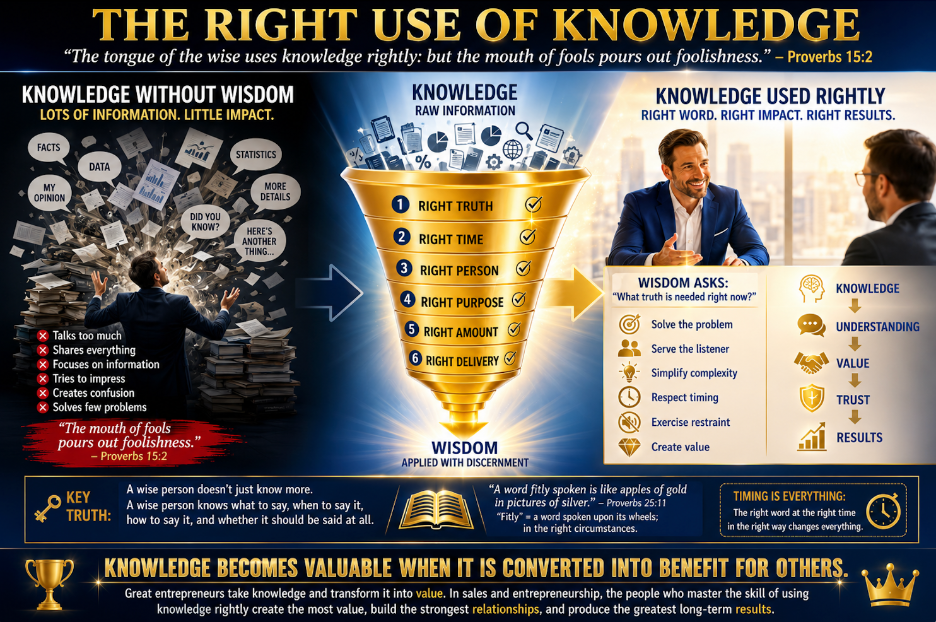
Using Knowledge Rightly Means Applying It Appropriately: Knowledge asks: “What is true?” Wisdom asks: “What truth is needed right now?”A mechanic doesn’t replace every part in an engine. A salesperson shouldn’t unload every fact they know about a product. Wise people select the right knowledge for the situation. Many sales presentations fail because the salesperson is displaying knowledge rather than solving a problem.
Using Knowledge Rightly Means Considering Timing: Even true information can become destructive when delivered at the wrong time. Wise entrepreneurs learn that timing is often more valuable than information. You’ve heard the expression, “timing is everything”… Well Solomon said “A word fitly spoken is like apples of gold in pictures of silver.” (Proverbs 25:11) “Fitly” here means, “A word spoken upon its wheels” or “A word spoken in the right circumstances.” It means a word that arrives exactly where it belongs and exactly when it is needed.
As much as I would like to elaborate on timing here, it is not the right time for that, but I’ll give you a cryptic hint… When you discover the hidden symbol buried in the Old Testament some 10,000 times but only translated roughly 200 times, one of which is in Ecclesiastes 9:11, you will begin to know the mystery. (If you’re in JSB, feel free to ask me about in our monthly meetup on Friday.)
Using Knowledge Rightly Means Speaking for the Benefit of the Listener: Many people speak to prove they are intelligent. Wise people speak to create understanding. In business this means asking:
- What does this customer need to understand?
- What will help this prospect make a good decision?
- What information will move this project forward?
The wise are not trying to impress. They are trying to serve. As it says in Proverbs 18:13, “He who answers a matter before he hears it, It is folly and shame to him.“
Using Knowledge Rightly Means Knowing What NOT to Say: One of the greatest business skills is restraint. Not every observation needs to be voiced. Not every advantage needs to be advertised. You can talk right past a sale. A wise person often demonstrates wisdom through silence. The fool in Proverbs frequently reveals himself by excessive speech.
Using Knowledge Rightly Means Translating Complexity Into Clarity: Experts often overwhelm people. Wise people simplify. Jesus continually took profound truths and translated them into everyday things like seeds, birds, vineyards, etc. He used knowledge rightly. The entrepreneur who can explain a complex service simply often outsells the expert who cannot. It’s the ability to translate the unfamiliar into the familiar.
Using Knowledge Rightly Means Matching Truth to Design: Knowledge used rightly recognizes that different people need different guidance. You would not advise a bird to swim, a fish to climb, or an eagle to live like a penguin. Likewise, a wise salesperson or business owner helps people discover what uniquely fits them, rather than forcing everyone into the same mold.
Using Knowledge Rightly Means Creating Value: Knowledge has little value until it produces understanding, better decisions, solved problems, reduced risk, increased productivity, greater fruitfulness, etc. Learn to use your very words to impart value to the hearer. They will usually reciprocate.
In other words, knowledge becomes valuable when it is converted into benefit. That is exactly what great entrepreneurs do. They take knowledge and transform it into value for others. And in sales and entrepreneurship, the people who master the skill of using knowledge rightly are often the ones who create the most value, build the strongest relationships, and produce the greatest long-term results.
Yes indeed we need to add value and help people voice exactly
what it is they need, I love it, thank you Michael
Puleng Ramataboe
Thank you Puleng for your kind comment. So glad you found this blog helpful!
Indeed, I’ve found this quite revelatory, knowledge,wisdom and understanding. Our speech should be full of grace and impactful to others.
Thankyou Michael.
Amen John… Thanks for commenting!